
What Can a Sinus CT Reveal When Symptoms Are Worse on One Side?
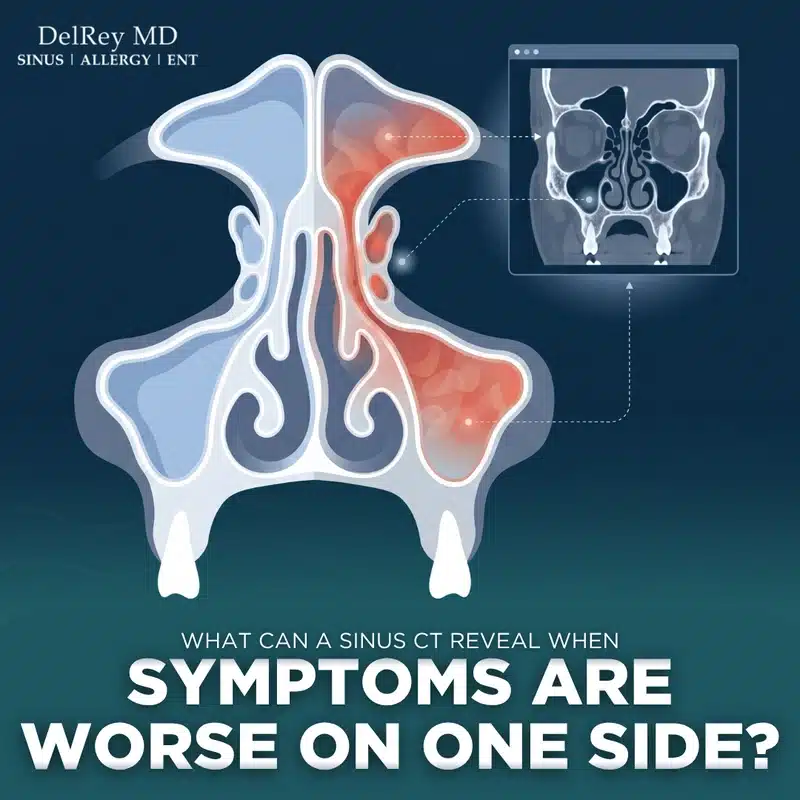
Persistent sinus issues such as nasal congestion, breathing difficulties through the nose, postnasal drip, and facial and sinus pressure can be frustrating, especially if symptoms seem to be concentrated or worse on one side.
Some cases of persistent one-sided sinus issues can have a straightforward cause, such as enlarged turbinates or a deviated septum. However, other cases may need additional evaluation to determine the underlying cause and other contributing factors.
An office examination can be a useful first step to evaluate symptoms and determine the extent of the issue. If additional information is needed to establish a diagnosis or create a treatment plan, your ENT care provider may recommend additional testing such as a sinus CT scan to evaluate sinus structures that cannot be completely seen during a routine nasal examination.
Our team here at Del Rey MD can help patients in Marina Del Rey, Long Beach, and Bakersfield, CA, understand what a sinus CT is and what it can reveal about persistent one-sided sinus issues.
What Can a Sinus CT Show About One-Sided Symptoms?
A sinus CT scan can show whether one side has more extensive sinus changes or anatomical narrowing than the other side. CT scan results may help identify:
- Blocked sinus drainage pathways
- A deviated septum
- Enlarged turbinates
- Thickening of the sinus lining
- Fluid buildup
- An abnormal area requiring further evaluation
However, sinus CT findings do not always establish the exact cause of an abnormality or explain a patient’s symptoms. Results should be interpreted alongside the patient’s symptoms, clinical findings, and medical history.
What Is a Sinus CT Scan?
A CT scan, or computed tomography scan, is a diagnostic imaging tool that uses specialized X-ray and computer processing technologies to produce detailed cross-sectional images of targeted areas of the body.
A sinus CT scan is a diagnostic tool that can provide detailed images of the nasal passages, paranasal sinuses, drainage pathways, and the surrounding structures. Results from a sinus CT scan allow ENT specialists to evaluate:
- The individual sinus cavities
- Sinus drainage pathways
- The nasal septum
- The turbinates
- The surrounding bones and anatomical structures
- Certain soft-tissue abnormalities
- Fluid or secretions in the sinuses
- Thickening of the sinus lining
A sinus CT scan can show structural changes and patterns of sinus disease that may not be visible or completely seen during a routine nasal examination.
What Happens During a Sinus CT?
During a conventional CT scan, the patient lies on a padded table that moves through a ring-shaped scanner. The scanner then captures multiple images of the sinuses from several angles, which are then processed into a detailed image of the nasal and sinus anatomy.
Some ENT clinics use specialized scanners that allow patients to sit or stand during the process. The procedure is generally noninvasive and takes a short time, although actual appointment time varies.
Patients are asked to remain still while images are captured. CT imaging uses ionizing radiation, so an ENT care provider will consider whether the expected diagnostic benefits justify the exposure before recommending the additional examination.
What Can a Sinus CT Show When Symptoms Are Worse on One Side?
Sinus symptoms that seem to be worse on one side can have several causes and contributing factors. A sinus CT scan may provide information about the following findings:
1. One-sided sinus inflammation
Sinusitis is the irritation, swelling, and inflammation of the tissues lining the sinuses. Sometimes, inflammation is more prominent on one side. A sinus CT scan may show:
- Changes around sinus drainage pathways
- Thickening of the sinus lining
- Fluid buildup within a sinus cavity
- Partial or complete opacification
- Involvement of one or several sinus cavities
2. Narrowed sinus drainage pathways
Each sinus cavity drains through a relatively small opening. Structural changes such as inflammation, polyps, or other conditions can further narrow these pathways and interfere with normal sinus flow and drainage.
A sinus CT scan can help map the deeper sinus drainage anatomy that cannot be fully seen and evaluated during a standard nasal examination.
3. A deviated septum
A deviated septum is an anatomical variation in which the nasal septum, the wall of bone and cartilage that separates the left and right nasal passages, is off-center. Depending on its location and severity, the deviation may narrow one or both nasal passages and contribute to breathing difficulties.
A sinus CT scan can show the position of the nasal septum and its relationship to surrounding structures. However, a visible septal deviation does not automatically mean it’s what’s causing the symptoms. CT findings should be evaluated alongside clinical findings, symptom severity, and the side of the blockage.
4. Enlarged turbinates
The turbinates are structures along the sidewalls of the nose that help warm, filter, and humidify inhaled air. Sometimes, they can become irritated and swollen due to allergens, irritants, infections, and other inflammatory conditions.
A sinus CT scan may show enlarged turbinates. These findings are evaluated to determine whether they correspond with the patient’s symptoms and experiences.
5. Nasal polyps and other soft-tissue findings
Nasal polyps are soft, painless, and noncancerous growths that can develop along the nasal and sinus lining. Sometimes, they become swollen and inflamed, which may contribute to nasal congestion, postnasal drip, reduced sense of smell, and impaired sinus drainage.
A sinus CT may show soft-tissue changes or areas of obstruction that could be consistent with nasal polyps. However, a nasal examination or endoscopy may be needed to better characterize these findings.
6. Dental-related sinus inflammation
Because the roots of the upper teeth are located close to the maxillary sinuses, a dental infection, implant, extraction, or another dental condition may sometimes contribute to inflammation in the nearby sinuses.
A CT scan may show findings that could suggest a dental-related source of inflammation. However, it does not replace a dedicated dental examination or dental imaging.
7. An abnormal growth or mass
A sinus CT scan may help identify an abnormal soft-tissue area, sinus expansion, or changes in the nearby structures. However, findings do not determine exactly what causes the abnormality, and other diagnostic tools may be recommended for further evaluation.
While most one-sided sinus symptoms are not due to cancer, persistent unilateral symptoms, especially when accompanied by facial swelling and numbness, recurrent bleeding, or vision changes, should be evaluated.
8. Fungal material
Certain fungal sinus conditions can affect one or more sinuses and may be associated with persistent sinus symptoms. CT imaging may show findings that could raise suspicion for fungal material. However, additional evaluation and interpretation should be considered to establish a diagnosis and determine the appropriate treatment plan.
When Should One-Sided Sinus Issues Be Evaluated?
Consider scheduling an appointment with an ENT specialist if you are experiencing:
- Blockage in the same nostril that persists for several weeks
- Nasal congestion that does not improve despite medical management and treatment
- Persistent nasal obstruction that interferes with daily activities, exercise, sleep, and comfort
- Symptoms that occur alongside recurring sinus infections or facial pressure
- A reduced sense of smell
- Recurring one-sided nosebleeds
Moreover, seek immediate medical care if you are experiencing severe facial pain or pressure, severe headaches, neck stiffness, swelling around the eyes, vision changes, confusion, or other sudden or concerning symptoms.
Understanding Your Sinus Symptoms and When You Might Need a Sinus CT Scan
Del Rey MD provides ear, nose, and throat care services for patients in Marina Del Rey, Long Beach, Bakersfield, and the surrounding California communities. Schedule an appointment with our team to learn more about sinus symptoms that seem to be worse on one side and how a sinus CT scan may help identify underlying problems and contributing factors.